Warning labels: new EU directive makes the labelling of single-use plastic mandatory
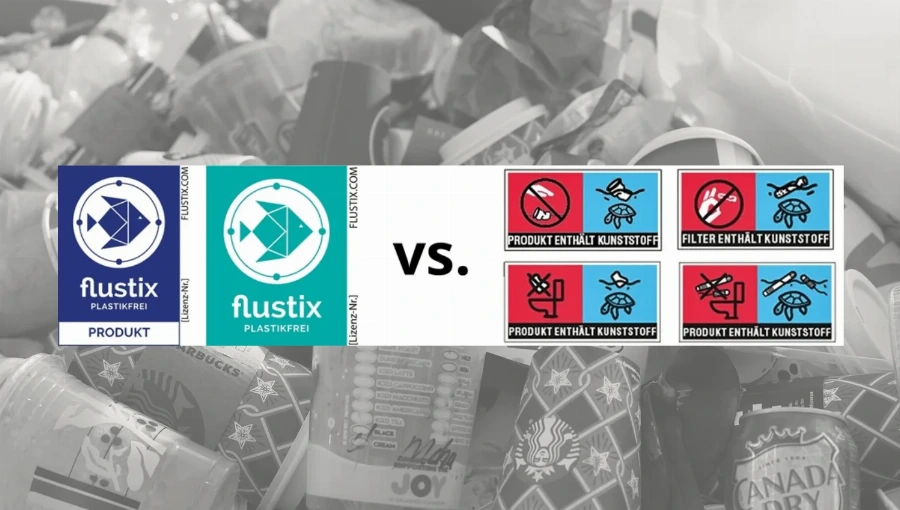
flustix offers the safe alternative for plastic-free products
The EU-wide ban on marketing single-use plastic articles applies from 3 July 2021. The exception: for certain products a labelling requirement applies instead. The warning labels may only be left off if freedom from plastic has been proven. flustix offers a recognised and reliable certification system for plastic-free products.
Berlin, April 2021. In the interest of a more sustainable approach to plastics, a new EU directive comes into force on 3 July 2021 banning certain single-use plastic articles. In addition, a labelling requirement is being introduced for a number of single-use products for which, in the words of the German federal government, “there are currently no ecologically more sensible alternatives”; the government will implement this requirement on 3 July 2021 as well, through Implementing Regulation (EU) 2020/2151[1]. But what about innovative manufacturers who already offer plastic-free alternatives today, yet have a healthy respect for the fine of up to 100,000 euros in the event of a breach?
Only those who have their products independently tested, assessed and certified are on the safe side
The only public seal Europe-wide that currently provides such proof independently, credibly and transparently is flustix, together with its partners the Wessling Group and DIN CERTCO (TÜV Rheinland). flustix certification as a “plastic-free complete product” or “plastic-free product” therefore offers security to all innovators – while adding value at the point of sale at the same time.
From July of this year, plastic crockery, cutlery, stirrers and drinking straws, as well as beverage cups made of expanded polystyrene and cotton buds containing plastic, may no longer be traded, while exceptions apply to other single-use products[1]. Filters for tobacco products, beverage cups and hygiene products such as wet wipes, sanitary towels and tampons, among others, may continue to be placed on the market provided they carry the prescribed warning labels clearly on the packaging or on the product itself. The reasoning given by the European Commission and the German federal government: since “there are currently no ecologically more sensible alternatives”[2] to these products, they are exempt from the general ban. “There are already a number of pioneers who have found a way to offer articles from the EU and government list without plastic. For them it will now be important to stand out and to protect themselves. Since 2017 we have been providing, together with renowned partners, the labelling certainty that is becoming even more important now – for consumers too. Or, to put it casually: a happy fish instead of a dead turtle at the point of sale – that is our mission,” says Malte Biss, founder of flustix.
flustix reliably certifies plastic-free articles and thus provides legal certainty. The multi-stage testing and licensing procedure – with WESSLING as the independent testing laboratory and DIN CERTCO as licensing partner – can be applied for without complications.
[1]https://www.bundesumweltministerium.de/pressemitteilung/warnhinweis-fuer-wegwerfplastik-ab-juli-2021
[2] https://eur-lex.europa.eu/legal-content/DE/TXT/PDF/?uri=CELEX:32019L0904&from=DE
Press contact
BISS PR & Communications
E: flustix@biss-pr.de
T: 030 809 33 31-01
W: www.biss-pr.de