
flustix statement on the UBA study on certification systems for recycled plastics
German Environment Agency makes 70 flustix-related editorial changes following flustix objection
Update of 21 September 2026
The German Environment Agency has reviewed the study and issued a corrected second edition in September 2026. The updated version of this statement follows directly below. The original version of 8 September 2026 remains unchanged at the end of this page, so that it stays traceable what was published when.
flustix welcomes correction of the UBA study on certification schemes for recycled plastics
The second edition contains 70 flustix-related editorial amendments: the current flustix RECYCLED Certification Programme was not evaluated.
flustix fundamentally welcomes the German Environment Agency’s examination of certification schemes for recycled plastics and its contribution to the development of credible verification systems for recycled content. However, any reliable public assessment requires the schemes under review to be identified unambiguously and historical schemes to be clearly distinguished from current ones.
Following information provided by flustix, the German Environment Agency (Umweltbundesamt, UBA) reviewed its study “Analysis and Evaluation of Certification Systems for Recycled Plastics”, published as UBA-TEXTE 130/2026 in August 2026, and issued a corrected second edition in September 2026.
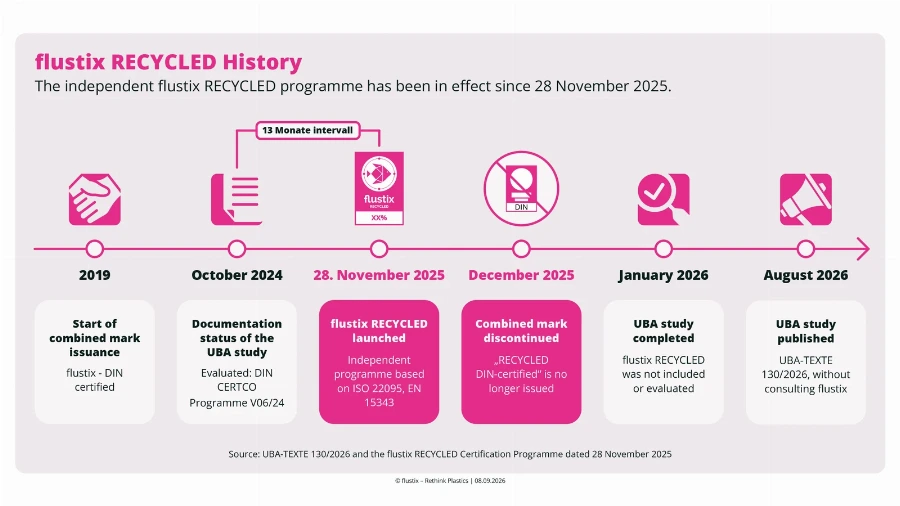
The most important clarification is that the independent flustix RECYCLED Certification Programme, published on 28 November 2025, was not part of the investigation and was not evaluated by the German Environment Agency.
The second edition therefore documents the outcome of the review announced by the UBA.
70 editorial amendments across 44 pages
A comparison of the original publication with the second edition identifies a total of 70 flustix-related editorial amendments across 44 of the PDF’s 163 pages:
- 54 existing references were clarified to read “flustix RECYCLED – DIN-Geprüft”;
- 14 new notices explain the distinction from the current flustix RECYCLED Certification Programme;
- a record of the amendments was added to the imprint;
- one further abbreviated reference was removed.
At key points throughout the report, the UBA now expressly clarifies that the evaluation was based on the former certification programme “Products made from recycled material – flustix V06/24”, issued by DIN CERTCO. Until the end of November 2025, this programme formed the basis for awarding the former combined certification mark “flustix RECYCLED – DIN-Geprüft”.
By contrast, the independent flustix RECYCLED Certification Programme, published by FLUSTIX GmbH on 28 November 2025 following preparatory technical work by a consortium of experts, was not part of the study. This distinction now appears in the imprint, comparison tables, evaluation results and profile of the historical scheme, among other sections.
flustix welcomes this unequivocal clarification. It is essential because the abbreviated name “flustix RECYCLED” used in the original edition created the impression that the findings related to the certification programme currently available on the market.
What the correction does not change
The second edition now distinguishes the historical combined certification mark from the current flustix RECYCLED Certification Programme. However, no substantive reassessment of the historical programme was undertaken.
The following elements remain unchanged:
- the score and resulting position of the historical programme;
- the substantive criticism of the former DIN CERTCO programme V06/24;
- the underlying evaluation matrix and its weighting;
- the account of the technical exchange with the former scheme owner and operator, DIN CERTCO, that did not take place.
The study continues to rank the historical scheme last among the systems examined, with 65 out of 176 weighted points and 29 points without weighting.
These scores relate exclusively to the historical documentation of the programme issued by DIN CERTCO. Following the end of its cooperation with flustix, DIN CERTCO has continued the programme under the name “Products made from recycled material – DIN-Geprüft”. The evaluation must therefore not be transferred to the current flustix RECYCLED Certification Programme.
flustix was not contacted during the investigation
It must also be noted that flustix was not contacted at any stage of the investigation, either by the German Environment Agency or by the experts involved.
In particular, flustix:
- was not informed about the ongoing investigation;
- was not asked to provide additional documents or technical information;
- was not presented with the experts’ outstanding questions;
- was not involved in the review of the preliminary findings;
- was not invited to comment before publication.
Although the study describes contact with the “scheme operator”, the corrected edition identifies DIN CERTCO as the owner and operator of the historical programme under review. The statement that more extensive cooperation was not possible due to a lack of capacity therefore does not refer to flustix and must not be interpreted as a lack of willingness on the part of flustix to cooperate.
The second edition still does not expressly clarify that flustix itself was never contacted.
flustix would have contributed fully to a technical clarification at any time. Since its foundation, the company has regularly worked with public authorities, research institutions, NGOs and other specialist organisations.
The evaluation remains subject to reservations
The experts themselves state that their assessment of the historical scheme is subject to reservations because of the insufficient depth of the available information and the technical exchange that did not take place. They expressly acknowledge that misinterpretations cannot be ruled out.
Furthermore, the supplementary review of practical implementation did not identify any publicly accessible evidence of incorrect certifications, violations or practical deficiencies relating to the scheme under investigation.
The evaluation result is therefore based largely on the documentation available during the research period and on unanswered detailed questions. It does not constitute evidence of practical deficiencies in completed certifications.
The current flustix RECYCLED Certification Programme
The independent flustix RECYCLED Certification Programme was published on 28 November 2025. The former combined certification mark “flustix RECYCLED – DIN-Geprüft” has not been awarded since that time.
The current programme addresses numerous matters criticised in the UBA study with regard to the historical version. These include:
- the explicit application of DIN EN ISO 22095 for chain of custody;
- reference to DIN EN 15343;
- more specific requirements for traceability and material flows;
- requirements concerning material inputs, material outputs and process losses;
- warehouse management, batch allocation and inventory controls;
- detailed mass-balance calculations and plausibility checks;
- separate recording and declaration of post-consumer recyclate (PCR) and post-industrial recyclate (PIR);
- enhanced requirements for auditing, documentation and conformity assessment;
- requirements for the quality management of the licensed companies;
- requirements under the REACH Regulation as well as specific evidence for food contact materials;
- cooperation with several independent certification bodies.
Whoever tests does not certify
The roles are clearly separated in the current programme as well. flustix owns the scheme and writes the certification programmes, but does not carry out the testing and does not issue the certificates.
Any analytical testing required is carried out exclusively by independent laboratories accredited to DIN EN ISO/IEC 17025. The audits by trained auditors, the conformity assessment and the certification itself are carried out exclusively by independent certification bodies accredited to DIN EN ISO/IEC 17065. This separation is the reason the mark works as evidence towards third parties.
These requirements were not part of the UBA evaluation. The scores awarded to the historical programme therefore do not allow any conclusions to be drawn regarding the quality, traceability or depth of verification of the current flustix RECYCLED Certification Programme.
Our view forward
We would expressly welcome it if the German Environment Agency were to examine and evaluate the current flustix RECYCLED Certification Programme in a future update of the study, or the revised programme that will follow shortly.
We would support such an examination openly, transparently and on our own initiative. In a market where robust recycled content evidence is becoming more important in regulatory and economic terms, certification schemes should be measured against their current requirements, verification mechanisms and evidence structures.
For us the correction is therefore not only a clarification about the past. Above all it creates a sound basis for the technical discussion about what robust recycled content evidence has to look like today and in the future.
Conclusion from flustix
flustix welcomes the fact that the German Environment Agency addressed the misleading attribution and comprehensively revised the report. The 70 editorial amendments demonstrate that an unambiguous distinction between the historical combined certification mark and the current flustix certification programme was necessary.
The decisive point is now clear: the study evaluated the historical certification programme V06/24 issued by DIN CERTCO, which formed the basis for awarding the former combined certification mark “flustix RECYCLED – DIN-Geprüft”. The independent flustix RECYCLED Certification Programme in place since 28 November 2025 was neither investigated nor evaluated.
flustix remains available to the German Environment Agency, the institutes involved and all interested market participants for open and technically informed dialogue. flustix would expressly welcome an evaluation of the current flustix RECYCLED Certification Programme and would proactively support such an evaluation at any time.
Key questions and answers
Did the UBA evaluate the current flustix RECYCLED Certification Programme?
No. In the corrected second edition, the UBA expressly clarifies that the independent programme published on 28 November 2025 was not part of the investigation.
What was actually investigated?
The study examined the former certification programme “Products made from recycled material – flustix V06/24”, issued by DIN CERTCO. Until the end of November 2025, this programme formed the basis for awarding the combined certification mark “flustix RECYCLED – DIN-Geprüft”.
How extensively did the UBA amend the study?
The document comparison conducted by flustix identifies 70 flustix-related editorial amendments across 44 PDF pages. These include 54 clarifications of the programme name and 14 newly added explanatory notices.
Was flustix involved in the original investigation?
No. flustix was neither contacted nor asked to provide documents. The preliminary findings were also not submitted to flustix for review or comment.
Was the evaluation itself changed?
No. The score, ranking and substantive evaluation of the historical programme were not recalculated. However, they must not be applied to the current flustix RECYCLED Certification Programme.
Does flustix RECYCLED currently incorporate ISO 22095?
Yes. The current programme expressly refers to DIN EN ISO 22095 and DIN EN 15343 and contains corresponding requirements for chain of custody, traceability and material-balance calculations.
Note on the counting methodology: The original publication was compared with the second edition of UBA-TEXTE 130/2026 published in September 2026. Changes resulting solely from page reflow or the consequential renumbering of footnotes were not counted as separate amendments.
- Current certification programme flustix RECYCLED
- Revised UBA study, second edition, September 2026: Analysis and Evaluation of Certification Systems for Recycled Plastics
Original version, as of 8 September 2026
The following text is the first version of this statement, published on 8 September 2026. It remains unchanged and is not amended retrospectively. The authoritative text is the updated version above, as of 21 September 2026.
In August 2026 the German Federal Environment Agency (UBA) published the study “Analysis and assessment of certification systems for recycled plastics” (UBA-TEXTE 130/2026). It assesses a system under the name “flustix RECYCLED DIN-geprüft” and subsequently refers to it in more than 50 places in the shortened form “flustix RECYCLED”.
That assessment does not, however, concern the current flustix RECYCLED certification programme.
UBA reviews the study
After being contacted, the Federal Environment Agency informed flustix that it has initiated a technical review of the matter. The institutes involved in the study are being included in this clarification. The UBA will then decide whether, and in what form, the publication needs to be amended or placed in additional context.
flustix welcomes this step and is available for the further factual review.
What was actually examined in the UBA study?
According to the study, the assessment was based on the document status of October 2024. The material evaluated was in particular:
- the certification scheme “Products from recycled material – flustix V06/24” issued by DIN CERTCO;
- the DIN CERTCO testing, registration and certification regulations;
- the DIN CERTCO conditions for external experts.
This was the basis of the cooperation at the time and of the former combination mark “flustix RECYCLED DIN-geprüft”.
The standalone flustix RECYCLED certification programme, fully revised by a panel of experts, was published on 28 November 2025. Since then, the former combination mark with DIN CERTCO has no longer been awarded.
Today’s flustix RECYCLED certification programme was therefore already publicly available before the study was completed in January 2026, but it was not included in the examination.
Key criticisms in the UBA study concern a superseded version of the scheme
Several substantial criticisms in the UBA study are already addressed in the flustix RECYCLED certification programme that has been in implementation since December 2025. These include in particular:
- the explicit application of DIN EN ISO 22095 for chain of custody;
- specified requirements for the traceability of recyclate origin;
- detailed specifications for material input, material output, material flows and process losses;
- requirements for warehouse management, batch allocation and physical stock controls;
- verifiable mass balancing and plausibility checks;
- consideration of fillers, virgin materials and further product components;
- separate recording and declaration of post-consumer recyclate (PCR) and post-industrial recyclate (PIR);
- further developed requirements for auditing, documentation and conformity assessment.
The current flustix RECYCLED certification programme also works with several independent international certification bodies that are recognised for this scope. The organisational structure of DIN CERTCO discussed in the study therefore cannot remotely be transferred to today’s flustix RECYCLED system.
flustix was not involved in the examination
flustix was neither informed about the examination nor asked for supplementary documents. The preliminary results were not submitted to flustix for review or comment either.
According to the study, only DIN CERTCO was contacted. There, in-depth support was said to be impossible due to a lack of capacity. Elsewhere in the study, however, this is turned into an alleged “lack of willingness to cooperate”.
flustix was ready at all times to contribute to a factual review. No such request reached the company.
The study itself points to its limited significance
The authors state explicitly that the assessment is made subject to reservation because of insufficient depth of information, and that misinterpretations cannot be ruled out.
In addition, no publicly available indications of practical shortcomings, incorrect certifications or breaches by the system examined were identified. The poor ranking therefore rests largely on the assessment of the available documentation and on unanswered points of detail, not on established deficiencies in past certification practice under the combination mark.
Our request to the Federal Environment Agency
flustix has asked the Federal Environment Agency for a prompt clarification and correction. In our view it must be clearly recognisable that:
- the combination mark “flustix RECYCLED DIN-geprüft” has not been awarded since the end of 2025;
- the current flustix RECYCLED certification programme is not the subject of the study;
- the assessment is based on the DIN CERTCO scheme V06/24 and the document status of October 2024;
- flustix was not contacted and not involved in the review of the results;
- the results cannot be associated with the current state of flustix RECYCLED certification;
- the study makes no statement about the present state of flustix RECYCLED certification.
flustix has been and remains available to the Federal Environment Agency and the participating institutes for a full technical review at any time.
Short answers for orientation
Did the Federal Environment Agency assess the current flustix RECYCLED certification programme in the study?
No. What was assessed was the earlier DIN CERTCO certification scheme V06/24 and further DIN CERTCO documents with a document status of October 2024.
Since when has the current flustix RECYCLED programme applied?
The standalone flustix RECYCLED certification programme was published on 28 November 2025.
Does flustix RECYCLED take ISO 22095 into account today?
Yes. The current programme refers explicitly to DIN EN ISO 22095 and DIN EN 15343 and contains corresponding requirements for chain of custody, traceability and material balancing.
Was flustix consulted before the UBA study was published?
No. flustix was neither contacted nor were the questions or preliminary results submitted to the company for comment.
Why did flustix not take part in the study?
flustix was not contacted at any point during the study. flustix only learned of it on the day of publication, through references to the study, and was taken completely by surprise.
Would flustix have worked closely with the institutes carrying out the study?
Yes. Since its foundation in 2017, flustix has always worked closely with the UBA, has left no other institutional enquiry unanswered and has always contributed its full expertise in panels and consortia. That has not changed and will not change now, even after being left out by the UBA: critical exchange with NGOs, institutes and authorities is decisive for constructive progress and for developing trustworthy and recognised systems.
The current flustix RECYCLED Certification Programme as a PDF