
Study proves: sustainability has considerable revenue relevance
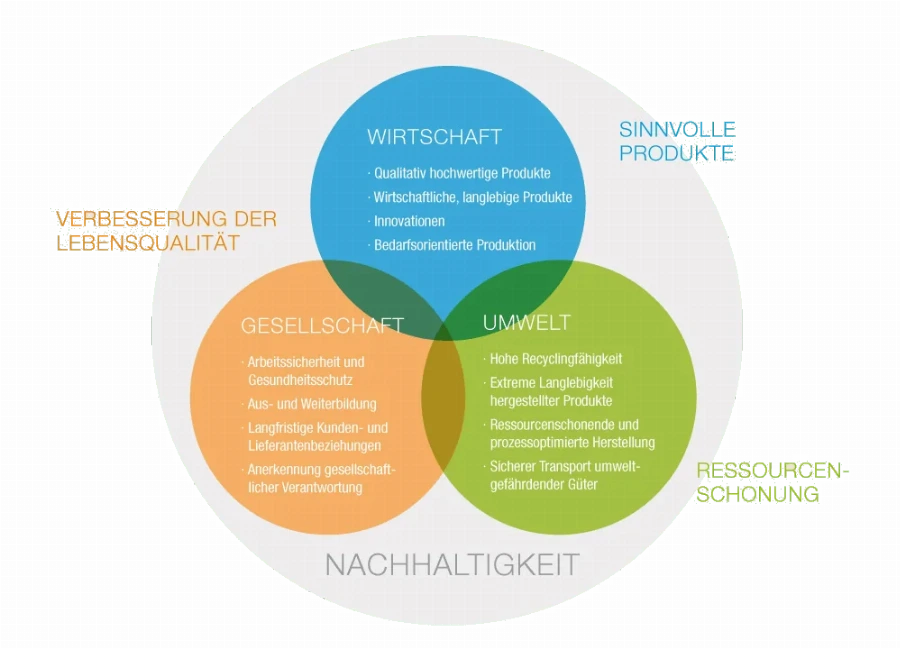
Sustainability accounts for up to 13 per cent of revenue. That is confirmed by a new study from the communications agency Serviceplan Corporate Reputation together with the management consultancy Biesalski & Company. As part of the Sustainability Value Score (SVS), the two partners also set out a roadmap for good sustainability management.
Can brands increase their value through sustainability by making a contribution to meeting non-material needs that is visible to their customers? Yes! The Sustainability Value Score (SVS), developed and implemented by Serviceplan Corporate Reputation and the management consultancy Biesalski & Company, shows that sustainability, as an essential aspect of reputation, is among a company’s most valuable capital. “Only recently the German economy provided dramatic examples of how value can be destroyed and what monetary damage that can cause. The reputational losses of Volkswagen and Deutsche Bank alone amount to billions in lost revenue and destroyed market value,” explains Joachim Schöpfer, founder and partner of Serviceplan Corporate Reputation.
Since 2011 the Berlin agency of the Serviceplan Group has been producing the “Sustainability Image Score” (SIS) together with Facit Research – the influential study that measures companies’ sustainability image from the consumer’s point of view and shows what influence sustainability has on corporate image, loyalty and overall satisfaction. The SVS now measures the concrete economic success of sustainability images and quantifies their share in explaining revenue.
Alexander Biesalski emphasises: “The study shows that sustainability images already contribute significantly to revenue in numerous industries and companies. But it also shows that in many places there is still ground to make up and that the potential offered by sustainability has not yet been exhausted.” The SVS now gives companies the chance to align their sustainability communication purposefully with business success.
Joachim Schöpfer adds: “When sustainability is used as a competitive factor, sustainable development as a whole benefits. With the SVS we provide the proof that sustainability pays off and can be operationalised as a competitive advantage.”
HiPP, Frosta, Alete and Iglo achieve more than 10%
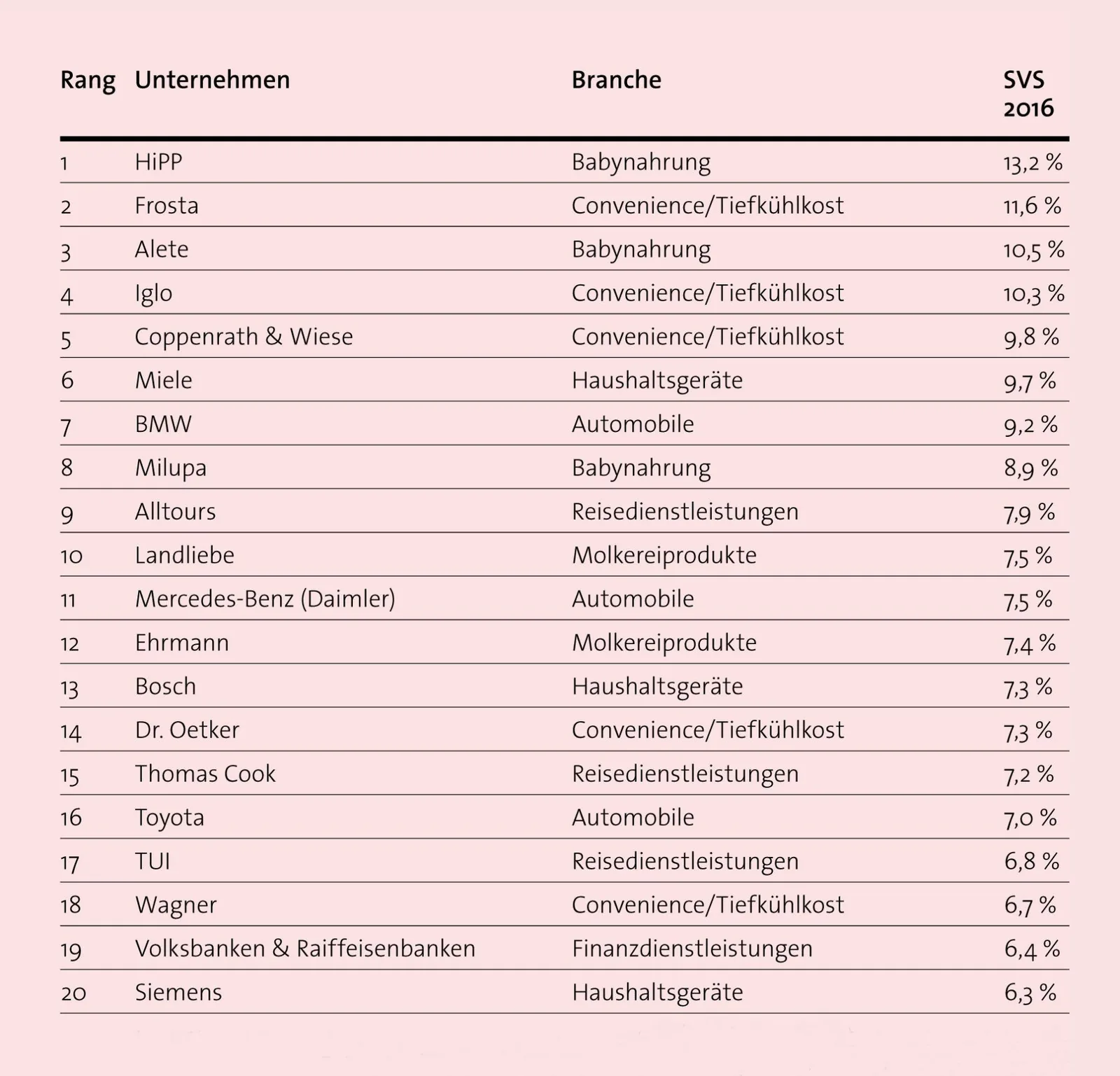
Four German companies can count on their good reputation for sustainability being responsible for more than ten per cent of their revenue: HiPP leads the ranking with 13.2 per cent, followed by Frosta with 11.6 per cent, Alete with 10.5 per cent and Iglo with 10.3 per cent. Fifth place, Coppenrath&Wiese with 9.8 per cent, also falls within the food sector. Places 6 and 7 are taken by Miele with 9.7 per cent and BMW with 9.2 per cent.
Roadmap for good sustainability management
As a guide to well-considered sustainability management, the study partners set out the following steps:
- Defining and personifying the target group(s)
- Identifying the genuinely relevant sustainability topics from the target group’s point of view. Well-founded analyses of the status quo and the potential
- Backing them with substance in terms of: what?, how? and why? Backing them with concrete, comprehensible lines of argument
- Developing sustainability as a differentiating competitive factor within the corporate strategy
- Checking credibility and potential for differentiation
- Translating the lines of argument into concrete communication measures and behavioural guidelines with tool support (workflow)
- Identifying the individually right channels, where the message is accepted, has a credible effect and reaches the defined target group widely
- Measuring the contribution to business success
The study
The calculation of the SVS is based on well-founded statistical analysis methods, so-called “multivariate analyses”. The data used to calculate the value contribution of sustainability come from the consumer survey by Facit Research collected for the analysis of the Sustainability Image Score (SIS) 2015. More than 8,100 buyers and customers of and about 104 companies from 16 sectors were surveyed for it.
In principle the quantification of the financial effect of sustainability is based on comparing a company’s perceived sustainability with purchasing behaviour from the consumer’s point of view. By comparing these two measurement dimensions across all respondents, it is determined to what extent purchasing behaviour is influenced by the perception of sustainability. That answers the question of whether a greater willingness to buy, or a higher purchase intensity, in relation to a company’s offers and products can be explained by buyers perceiving that company as more “sustainable”.
The thesis
“With our study we prove that reputation is a decisive factor in saturated and highly differentiated markets,” explains Joachim Schöpfer, adding: “When offers become ever more similar and interchangeable, it is reputation that takes on the added value of a brand: providing orientation and thereby creating trust.”
Sustainability is an essential part of reputation, because by demonstrating the revenue relevance of sustainability images, the SVS gives companies new impetus in building and communicating their reputation.
Download the full study as a PDF.
This article first appeared at Serviceplan.