The opportunities and gaps of the EU plastics strategy
The world, and not only Europe, is choking on plastic waste. Headlines about the record pollution of our planet and its consequences for health appear in the media daily at the moment. Consumers are increasingly aware of the issue and policymakers have responded at European level. So let us set the weighty discussion of the problem aside for a moment and take a closer look at the plastics strategy proposed by the European Commission: what exactly does the EU strategy for plastics look like? Are plastics to be avoided, or is the circular economy to be promoted? What are the fields of work, who has to implement them – and how realistic is the whole thing?
Around 1.5 million people currently work in the European plastics industry. They generate 350 billion euros in turnover every year, accounting for 18 per cent of global plastic production (source: Eurobarometer). Almost forty per cent of the plastic produced is used for packaging – and only thirty per cent of the plastic produced is recycled. What matters here is that the lion’s share of plastic consumption is limited to everyday consumer goods such as packaging. Not to sectors such as electronics, automotive or construction (source: European Commission). So the arithmetic is simple: we produce more single-use plastic than we recycle, and not only across Europe but globally. The solution seems simple: more recycling, more circular economy. A strategy already presented in 2015 by the President of the European Commission, Jean-Claude Juncker, in the context of the 2015 Paris Agreement and the “2030 Sustainable Development Goals”.
Facts and figures
- 8 million tonnes of plastic are produced in the EU every year, and more single-use plastic than ever is offered and therefore used. (Source: Plastics Europe)
- The European Research Centre has found that fully half of the waste on beaches consists of single-use plastic.
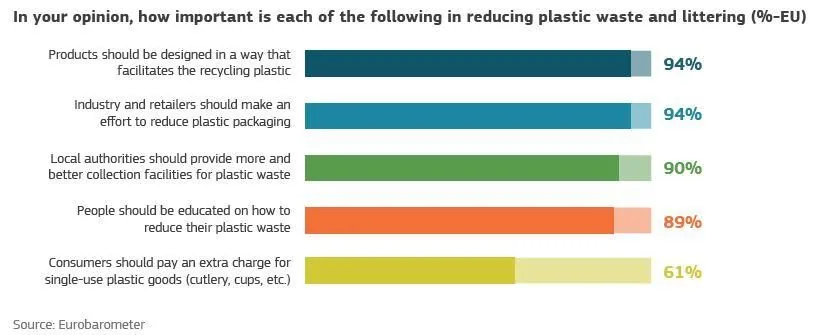
- 74% of the European population are concerned about their health when using products containing plastic. 87% are worried about the consequences for the environment. That emerged from a Eurobarometer survey.
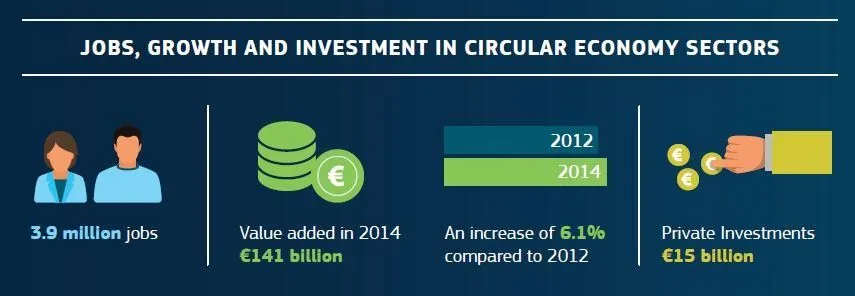
With the plastics strategy the European Commission has now finally created a legislative basis for implementing the 2015 plan. The strategy is certainly a clear step forward, but its implementation is not binding: first the EU member states have to integrate the legislation into their national and regional law. The relevant economic sectors also have to adapt technically and operationally to the requirements of the circular economy. By promoting a new Europe-wide circular economy, the Commission hopes for 200,000 new jobs in the waste industry by 2030.
On the urgent question of microplastics, which still appear far too often in cosmetics and cleaning products, the EU is unfortunately not very concrete. It did not issue a clear ban, only agreeing on a restriction. Ironically it is the departing country, the United Kingdom, that has already enshrined a ban on microplastics in cosmetics in law, while France is still discussing the matter and Germany continues to rely trustingly on the cosmetics industry voluntarily doing without microplastics. Another example of how difficult it is to implement European law and of how far German politics in particular obeys the business lobbies.
Fewer single-use bottles thanks to clean tap water?
The strategy is also somewhat vague on the question of access to drinkable tap water for EU citizens. The plastics plan does not address the provision of drinking water in concrete terms, nor does it gather any evidence as to whether clean tap water actually leads consumers to use fewer single-use bottles. Clean drinking water is of course an important goal regardless. In this context an opportunity was unfortunately missed to agree an EU-wide mandatory deposit system for beverage bottles.
Besides, consumers really ought to be given clear guidance when it comes to shopping. That could be achieved across Europe through legally mandatory labelling with product seals, as already exists in the rules for food. The European Commission, however, only wants to create incentives for labelling plastic and unfortunately does not make it binding for manufacturers. Nor was the proposal of a tax on plastic packaging and products included in the strategy or discussed – even though such a tax could well be conceived for manufacturers too, potentially allowing automated packaging with single-use plastic to be regulated strictly.
The EU plastics strategy in concrete terms
The European Commission wants to…
- make every kind of plastic packaging recyclable by 2030.
- promote durable and recyclable products.
- invest in more efficient collection, separation and recycling infrastructure.
- improve the traceability of the materials used on the production side, in order to guarantee a cleaner, safer material loop.
- create uniform quality standards for plastic recycling.
- create a green public procurement regulation for integrating recyclate and setting up deposit systems.
- award financial support to research and innovative projects in order to help companies recycle more.
In its strategy paper the EU writes very aptly: “It all starts with design.” In doing so it addresses not only materials research but also manufacturers, who are expected to put money into more environmentally conscious product and packaging design instead of producing cheaply and automatically with single-use plastic. Not only that – by 2030 all plastic packaging is to be recyclable. A very rough approach that is complex to implement. “What matters here is finally to stop confusing consumers: ‘recyclable’ should in future mean that new products can be made from old ones. ‘Recyclable’ must not mean that burning the material counts as recovery, which is unfortunately still the case for more than half of all plastic waste,” criticises Malte Biss of FLUSTIX.
In its plastics strategy the EU also promises funding for clear approaches. To date the EU has already released 250 million euros for research in this field – an additional 100 million will be invested by 2020 in developing more environmentally friendly materials and in removing hazardous substances and contamination from recyclate.
Where does the money go?
9 million euros go to the project CIRC-PACK, a project to develop compostable plastic. 3.7 million euros go to the company CLEAN SEA, which specialises in removing and preventing marine pollution and is to advise the EU on concrete clean-up policies in future. Beyond that, RES URBIS is to be supported with 3.3 million euros, a project that aims to produce bioplastics from urban organic waste. As is FORCE, a cooperation project for cities in which flexible plastic from production and from private households is to be recycled. Under the Juncker investment plan the EU awarded strategically relevant loans to Green Fiber International SA and initiated structural funds for more efficient waste management and for increasing Europe’s own recycling capacity.
The EU, too, has thus recognised that producing new plastic can, despite an ever-powerful oil lobby, no longer be justified economically or in climate terms. Juncker’s statement on this is a thoroughly golden moment for the EU:
“Europe must ensure we make our planet great again. It is the shared heritage of all humanity”
− European Commission President Jean-Claude Juncker in the State of the Union Address, 13 September 2017A comparatively large part of the strategy paper is fortunately devoted to marine pollution. Even more than in the strategy first proposed in 2015, the 2017 paper refers to the international standards of the MARPOL convention. Under this multilateral alliance, in place since 1973, more efficient collection of packaging waste in port transport is to be guaranteed in future. 7 million a year go to the organisation, which is to support ports, ships and the relevant expertise in port security and cleaning.
What else is the Commission doing?
The European Commission sees its further action in multilateral efforts to curb marine pollution in the East and South East Asian region, and in supporting the Barcelona Convention in the Mediterranean. In multilateral forums such as the United Nations, the G7 and the G20, the EU will continue to advance the plastics strategy. Diplomatically, too, the strategy has to be implemented, and bilateral, regional and thematic external investment plans have to be drawn up that aim at removing plastic waste from rivers and seas.
In coordination with the relevant sectors, well-designed deposit systems and recycling routes should ideally emerge. National, regional and local authorities are encouraged to make better use of the economic instruments available to them – in particular to raise the costs of landfill and incineration and, in return, to promote recovery and the avoidance of plastic waste. With its funding programme ‘Horizon 2020’ the EU holds out the prospect of a good tool for supporting national action.
And industry?
For the time being, industry is only called upon to make a “voluntary commitment” to supporting the strategy’s goals. Whether and how industry sees opportunities in the change proposed by the EU remains to be seen. A few questions in this context remain open:
- Will there be funding for converting value chains to plastic-free alternatives or to recyclate?
- How can the innovation coming out of research, which is to be generously supported financially here, also find its way into business?
- And how are existing production processes to be converted?
- We all know them, the wonderful new innovative approaches. Why does it take so long for business to let them flow into its production?