Fashion and plastic
Polyester as an environmental hazard
Plastic packaging, plastic toys, plastic tableware, plastic furniture, plastic appliances and even plastic clothes. You come across plastic everywhere. Wherever you look – plastic – even where you cannot see it – microplastics, liquid plastic. And what exactly is the situation with plastic in textiles?
Today we want to look at how to tell plastic-free fashion from fashion containing plastic. Because washing polyester fibres, for example, flushes the tiniest plastic particles into our drinking water. Worn on our skin, polyester is in direct contact with the body every day and can release tiny fibres and particles as well as harmful additives through abrasion and use, placing a long-term burden on the environment, animals and people.
Plastic hides in fashion in many forms
We at flustix therefore ask ourselves: what does clothing have to be like to earn our seal? First and foremost, of course, by doing without synthetic, petroleum-based fibres in woven and knitted textiles. That alone – careful! – rules out more than half of the goods on offer. Because around 60 per cent of clothing contains a great deal of polyester – and the share is still growing. That includes blended fabrics, which consist only partly of natural fibres such as cotton, wool, silk or linen.
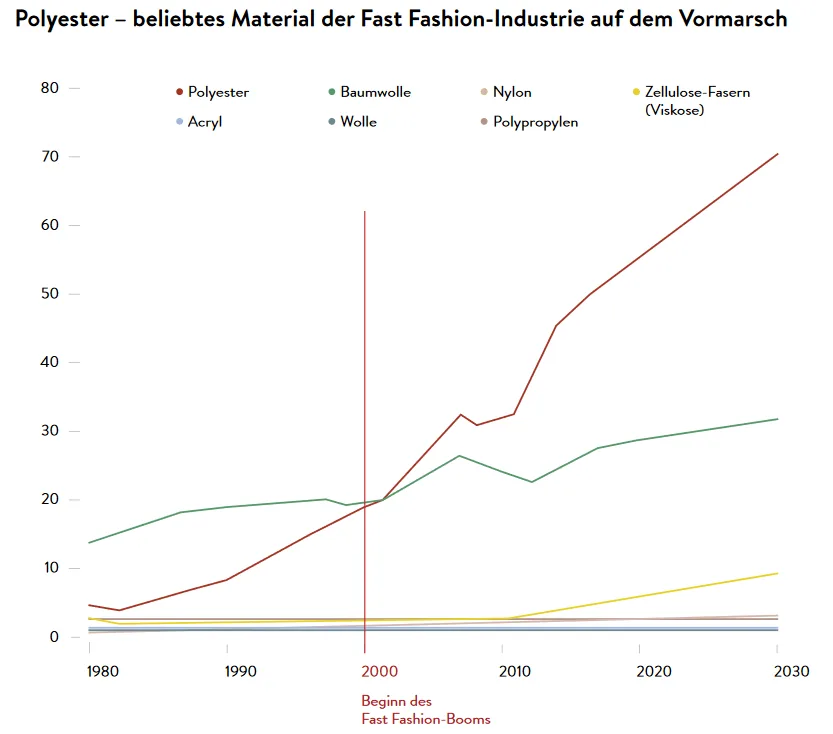
Growth in global fibre demand in millions of tonnes – 43.5 % of textile fibres are used for clothing. Chart based on Textile World (2015)
Such material mixtures offer attractive quality features: tear resistance, wash resistance and durability – which seems paradoxical given their short life as fast fashion items. What they really do is simply disguise the artificial, the cheap. Very much to the detriment of any possible reincarnation, because they are particularly difficult to break down again and return to biological and/or technical loops. Recycling garments made from pure natural fibres is easier, because unlike plastic they rot. Often, though, things come unstuck in hidden places, where components such as care labels and woven tapes are made of plastic and polyester thread holds the pattern pieces together. That is unfortunately widespread in the industry, likewise for reasons of durability. Ideally, then, producers would use sewing threads made of cotton or something similar.
This much chemistry is in textiles
Alongside polyester, synthetic man-made fibres include polyamide (nylon, Perlon), polyacrylic (Orlon, Dralon) and elastane (Lycra, made from polyurethane). Many people do not know that viscose, modal and acetate are produced chemically but obtained from cellulose – more precisely from wood. That is a renewable raw material in this part of the world, supposedly biodegradable and plastic-free, requiring less energy and water and no pesticides; even so, the viscose process scores badly in the Made-By ranking because of its high energy consumption, the use of various chemicals and the pollutants hydrogen sulphide and carbon disulphide produced in manufacturing.
Plastic-free fashion
There are more sustainable alternatives: the lyocell process uses the non-toxic, organic solvent NMMO and reuses it in a closed loop according to the closed loop principle – which is considerably gentler on the environment. It produces fibres from sustainably managed European beech wood or Asian eucalyptus wood.
Further innovative fabrics made from natural materials that are gaining momentum on the sustainability wind and sound promising go by the names of bamboo silk and soy or eucalyptus viscose, and are obtained from algae or milk proteins; some even bring health-promoting or skin-friendly properties with them. Some of these base raw materials are inherently gentle on the environment because they are generated from surpluses or grow back very quickly, like bamboo. Passing final judgement on their level of sustainability and how much sense they make is up to each individual and to good analysis, as far as information is available. In any case they claim naturalness for themselves, and thus apparently freedom from plastic too, and they are popular with modern green fashion labels.
Customers are still well advised to stick to materials that thrive in this part of the world and are naturally sustainable in cultivation and extraction. Hemp, for example, grows quickly, needs neither herbicides nor insecticides and gets by on very little water. A similarly robust fibre is obtained from the stalks of the flax plant and is known as linen. From further afield come cotton and silk, both of which can also be bought in organic quality. The market is developing and increasingly offering innovations, if unfortunately with a parallel trend towards greater use of polyester.
Caution is therefore called for, and it pays to shop consciously and well informed – even if that means leaving a beautiful item made of plastic on the rail and waiting for an even more beautiful garment that is entirely plastic-free and therefore thoroughly delightful.
We are here to help – so keep your eyes open for the flustix plastic-free seals!