How will the sea become plastic-free again? Through world-improvers and hashtags
Concepts for the ‘oceans’ rubbish collection’
Part two of our series continues where the excitement left off. After Boyan Slat set off into the Pacific with the Ocean Clean Up team – we will bring you an update on that soon – the next good idea for clearing the oceans of plastic waste is already here:
The Pacific Garbage Screening
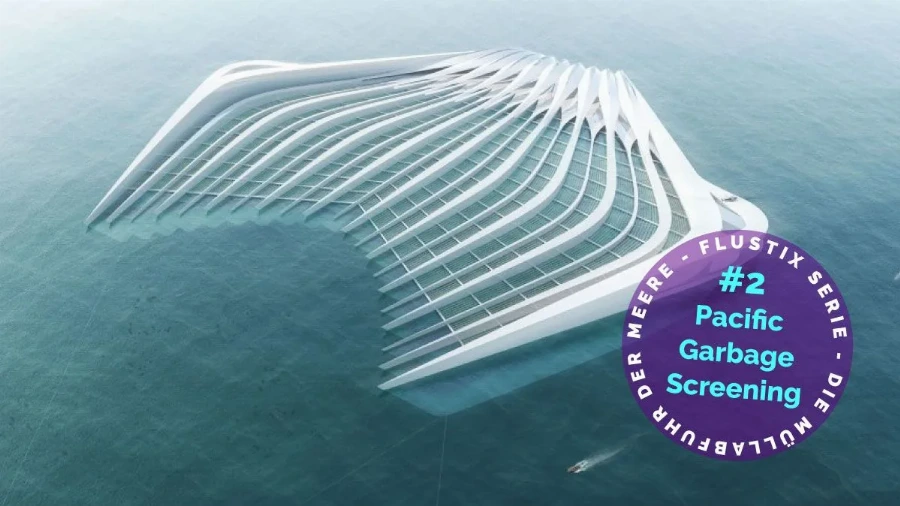
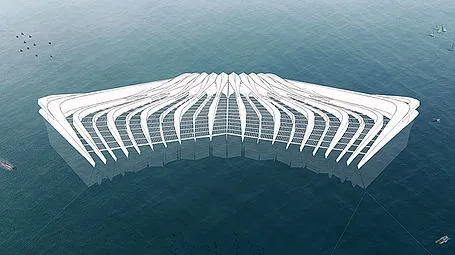
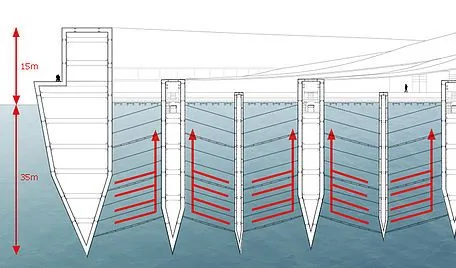
The Aachen architect Marcella Hansch has a vision of a sea vacuum cleaner that is equally ambitious, revolutionary and yet all her own: together with a volunteer team of some forty scientists and engineers she is working on a 400-metre futuristic platform in the elegant shape of a ray. Thanks to its special design, this floating island is meant to filter all kinds of plastic out of the water down to thirty metres below the surface – a concept called Pacific Garbage Screening (PGS).
Technological innovation
Entirely without nets, and thanks to a sophisticated architecture that gives plastic waste buoyancy by calming the current at specific points, larger and smaller plastic particles can then be skimmed from the surface. Marine animals should therefore not be endangered – they can simply swim through the structure. That said, we do wonder whether the whole thing might still affect other organisms, as the plastic rises or as microplastics are removed. According to Hansch, though, the biologists in the team will know how to prevent that, because environmentally compatible development is the top priority in every respect.
In addition, the harvested plastic is chemically converted into carbon dioxide and hydrogen. The former is intended for growing algae for biological plastics, the latter to supply the facility’s fuel cells. Marcella Hansch wants to change the world with it – and we can all help her do so – and it would certainly help us all.
The ‘Netz gegen Plastik’ initiative
With the hashtag campaign #netzgegenplastik, the self-styled Weltverbesserer (world-improvers) want to support the bold idea of the 32-year-old – who, after a diving holiday, was no longer willing to watch the pollution of the seas idly – in concrete terms with attention and funding. Behind it are the health insurer Techniker Krankenkasse and the Kiezhelden, the umbrella for social engagement at FC St. Pauli and its partners.
Money in exchange for a hashtag
As many euros as possible are to be collected within six weeks from 1 November. Every public use of the hashtag on Facebook, Twitter and Instagram is rewarded with one euro by the initiative, supporting Hansch’s project. Helping has rarely been this easy! Quick, do your bit now!
Saying goodbye to plastic waste at sea
Why take part? An explanation is hardly necessary. Plastic pollution of the seas is on everyone’s lips and has become the symbol of the human-made flooding of the world with plastic waste. The next step is for us to get inventive – not only in trying to curb plastic production and to make plastic-free products. In parallel we have to responsibly gather up, recycle or at least dispose of all those scattered plastic bags, straws, cotton buds and the rest. And with the dream called PGS we will hopefully come a step closer to that ambitious goal in five years’ time.
How do environmentalists assess such plans?
“In principle it is a good thing to take waste out of the oceans,” Dr Kim Detloff, marine conservation expert at the German nature conservation association NABU, said of the ocean clean-up plans back in February 2017 in an interview with the newspaper BILD. “But the focus should be only on so-called macroplastics, meaning larger pieces from 2.5 centimetres upwards. Attempts to remove the tiny beads of microplastics on a large scale are rather problematic, because plankton is fished out along with them.”
In his view, fishing out the waste can only ever be a temporary solution: “If people know that somebody is coming along to clear up, they carry on as before and do not change their behaviour.”
Collecting the waste only treats the symptoms, Detloff says: “It is far more important to prevent waste from reaching the sea in the first place. For that, people need a new awareness and have to reduce their waste drastically. A third of all plastic goes on packaging. But do bananas really need to be shrink-wrapped, and do we need large outer packaging for small products such as USB sticks?”
That is exactly what flustix has offered on the market since December 2017 – the solution demanded for so long. We certify plastic-free complete goods, products, packaging and/or contents free from microplastics, and thereby help business and consumers to play their part in the necessary change.