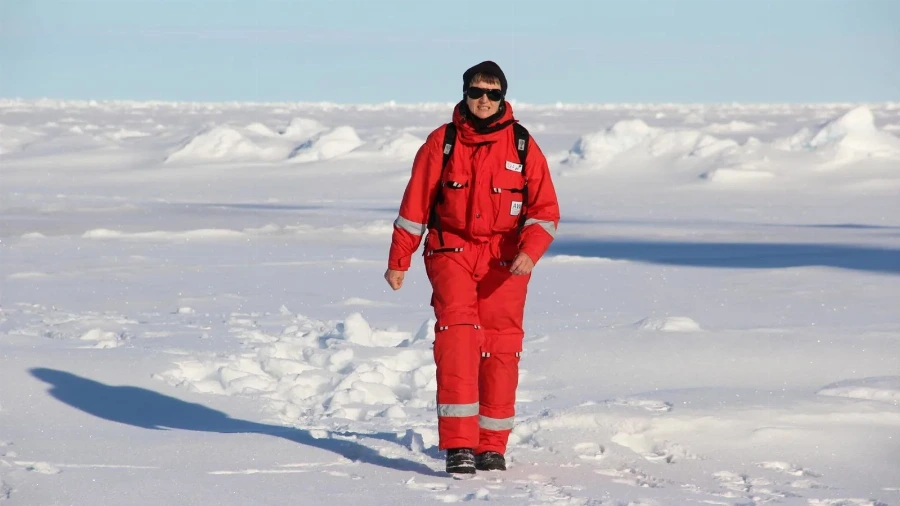
Expert interview: Dr Ilka Peeken finds plastic in the ice of the Arctic
FLUSTIX: What did you find in the Arctic, how far did the results shock you, and how bad is the scale of it?
Dr Ilka Peeken: We found more microplastics in Arctic sea ice than ever before. Most of the particles, however, were smaller than a twentieth of a millimetre. In the ice samples from five different regions of the Arctic Ocean we found between 1,000 and more than 12,000 microplastic particles per litre of melted sea ice. The composition of the plastic in the ice cores points to long transport routes from the Atlantic and the Pacific Ocean.
A new measurement method can analyse the tiniest plastic residues
FLUSTIX: How were you able to measure so precisely – is there a new measurement method?
Dr Peeken: Unlike previous studies of sea ice, where the filter surface was examined microscopically and only the particles believed to be plastic were then identified further using Fourier transform infrared microscopy (FTIR), we used imaging FTIR to scan whole areas of the filters. That minimises the human error that can arise from selecting particles visually. The imaging FTIR method used here covers the most information-rich infrared range of the spectrum from the outset. This measurement therefore allows us to capture all particles and, in particular, to detect very small ones (down to 11 µm).
FLUSTIX: What effects do the different plastics and sizes have on our environment and wildlife?
Dr Peeken: In principle, plastic particles can be and are “mistaken” for food and, depending on their size, ingested by organisms. Especially with the even smaller nanoplastic particles, that can lead to reactions ranging from inflammation to behavioural changes in fish. Other studies show, however, that the particles are also excreted again. There are also studies showing that toxins accumulate on microplastics that can be harmful to the animals that ingest them. Overall, pollution with plastic waste probably has far-reaching consequences for marine ecosystems and thus for people. A precise assessment of the actual consequences cannot yet be given, however.
Microplastics and nanoplastics trigger inflammation
FLUSTIX: Your personal view: where does this whole disaster end if we do not start acting now?
Dr Peeken: I would put it more positively: humanity has recognised the problem and is still quite capable of responding to it and preventing the disaster. That can only happen, though, if it is also recognised as a global problem and if investment is made immediately where the input is greatest.
FLUSTIX: Why do we here in Germany and Europe also have to rethink our approach to plastic?
Dr Peeken: Every piece that does not end up in the ocean is a good thing, and every consumer should therefore play their part. And that information has to be communicated in exactly those terms. Even so, we have to think globally and tackle the problem worldwide. That may also mean encouraging a rethink where most plastic currently reaches the oceans. Only if we start here will much move there.
FLUSTIX: How do you think we can get a grip on the issue?
Dr Peeken: Everyone has to realise that we cannot carry on like this, because we are producing and using a product that unfortunately does not “rot”. That means consumers should rethink their consumption and reconsider their use and handling of, for example, cigarette butts, shopping bags, packaged fruit and vegetables, fleece jackets and many other products. To do that, consumers have to be informed still further and integrated into solving the problem (through beach or city clean-up campaigns, for instance). At the same time, consumers should be given more access to goods with less packaging or biodegradable packaging, which could probably only be achieved through political intervention and which requires the relevant industries to act. Reliable labelling with institutional backing certainly makes sense here.
Consumers have a role to play in avoiding plastic too
FLUSTIX: What opportunity do recycling and the circular economy offer?
Dr Peeken: The article published in Die Zeit a short while ago makes it clear that “supposed” recycling also leads to an uncritical approach to plastic, above all here in Germany, where we give no thought to what happens to the plastic once it is in the yellow bag. For the time being I would therefore give higher priority to avoiding plastic products and to using naturally degradable ones. In principle, though, plastic is made from a non-renewable raw material, so recycling this product is already unavoidable for that reason alone. Recycling only makes sense, however, if new production does not exceed the share being recycled.
For the scientist, too, it is clear: plastic consumption has to be reduced
Dr Ilka Peeken is a marine ecologist, born in Wittmund in 1962. She studied marine biology at the University of Kiel and completed her doctorate there in 1997 on the subject of “Pigment biomarkers as indicators of pelagic processes in polar regions”. After a period abroad at the Scripps Institution of Oceanography in La Jolla, USA, Peeken worked at IFM-GEOMAR in Kiel and at MARUM – Centre for Marine Environmental Sciences in Bremen. Since 2013 she has been working on the ecology and biogeochemistry of sea ice at the Alfred Wegener Institute, Helmholtz Centre for Polar and Marine Research in Bremerhaven.