Microplastics in baby food and the question of what is really in the product
Greenpeace findings in food, new consumer figures and higher expectations of environmental claims show that manufacturers need robust knowledge of what their products actually contain. Not only for food, but also for solid and soluble consumer goods formulations on the retail shelf.
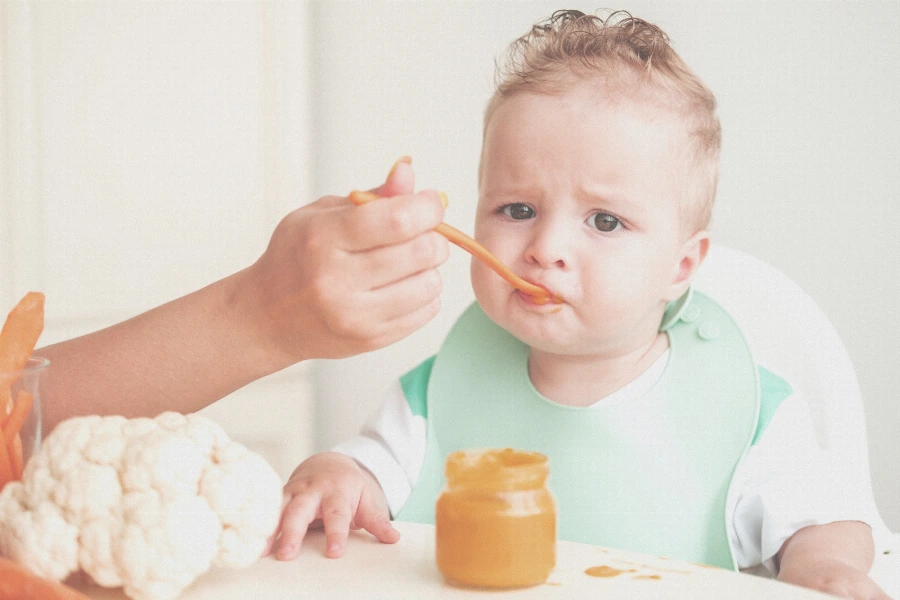
What is actually in baby food? A Greenpeace study caused a stir in May: microplastic particles were found in six squeeze pouches of two baby food products from the brands Gerber (Nestlé) and Happy Baby Organics (Danone). The Norwegian institute SINTEF Ocean extrapolated its findings to several thousand particles per pouch. Precision is needed when interpreting this, however: only two products were tested, with three pouches each. The figures are estimates based on subsamples, and the packaging was not conclusively proven to be the specific source.
A Consumer Reports study published in September also turns the spotlight on the food itself: 15 baby food purées tested showed evidence of microplastics. They included products in glass packaging. Raw materials, process water, equipment and packaging are all possible entry routes. Simply switching the packaging material therefore does not, on its own, answer the decisive question: what is actually in the finished product?
Consumers do not see particles. They see a promise.
Consumer concern is high: according to the latest BfR Consumer Monitor from the German Federal Institute for Risk Assessment, 84 per cent of respondents have already heard of possible risks from microplastics in food or cosmetics, 51 per cent are very or somewhat concerned and 44 per cent have actively tried to protect themselves from microplastics in the past year. An international study carried out jointly by the BfR and EFSA confirms the high level of concern and the willingness of many people to change their behaviour.
What makes microplastics special is that consumers cannot see, smell, taste or feel the tiny particles in everyday life. They have to be able to rely on product information. Respondents in the EFSA-BfR study also confirmed that independent evidence on the product, such as credible labels, influences purchasing decisions. The message for manufacturers is clear: anyone who can prove independently that a product is free of microplastics and communicate this clearly on the product itself provides orientation and gains an important argument at the point of sale.
This does not only apply to food. A detergent tab, chewing gum, cosmetics, a liquid or solid shampoo or a powdered formulation such as a supplement can also carry a microplastic-free claim at the point of sale. For such products, what counts is not only what was intentionally added according to the list of ingredients. What matters is whether microplastics are present. And this raises a clear question about the analysis: which particles can be detected in which product content under the test conditions defined for this purpose? Is the chosen analytical method suitable for this product matrix? Stand-alone solid articles such as textiles or sponges require different analysis from liquid or soluble matrices. Depending on the product, a different analysis may be needed to actually establish and prove the absence of microplastics.
From laboratory result to verifiable claim
How deep an investigation goes depends, among other things, on the size range it covers. The SINTEF study (Greenpeace) analysed particles from 20 micrometres upwards. The published flustix certification programme takes particles into account from as little as one micrometre. That is a programme-defined lower size limit that is smaller by a factor of 20, not a measurement accuracy that is twenty times higher across the board. Methods such as Raman microscopy for particle identification and TED-GC/MS for polymer-specific mass information are used depending on the material and the question being asked.
The decisive part is the next step: a laboratory report alone is not yet an independently certified product claim. flustix MICROPLASTIC-FREE combines product-related test requirements, analysis by qualified laboratories accredited to ISO/IEC 17025, independent conformity assessment and recurring monitoring into a certification system that can be used internationally. The result is independent certification, including a trustmark that manufacturers can use in B2B business as well as directly on products at the point of sale.
This makes a product property that no one can judge with the naked eye transparent for purchasing, retail and consumers. This is crucial in international distribution in particular: a defined testing and certification framework takes the place of differing self-declarations. What is certified is the specific product content within the defined and recognised scope and the corresponding detection limits.
The scientific debate about the possible health effects of microplastics continues; a comprehensive risk assessment by EFSA is still pending. That makes it all the more important to prove independently today what can be scientifically verified in the specific product content.
Whether it is baby food, cosmetics, chewing gum or cleaning products, consumers cannot tell whether microplastics are present. Manufacturers, however, can have this tested and independently certified. That is exactly what flustix MICROPLASTIC-FREE stands for: scientifically sound analysis, independent certification and credible labelling that turns a brand promise into a verifiable product property.
Certified product content, verifiable internationally: our programme page explains how flustix MICROPLASTIC-FREE is structured.
Sources
- Greenpeace / SINTEF: study on baby food (21 May 2026)
- BfR Consumer Monitor 2026, in German (16 October 2026)
- Consumer Reports: baby food testing (18 September 2026)
- flustix MICROPLASTIC-FREE: certification scheme
- EFSA: microplastics and nanoplastics in food