Opinion: SUPD at a turning point: Four years of legal uncertainty now require clear rules
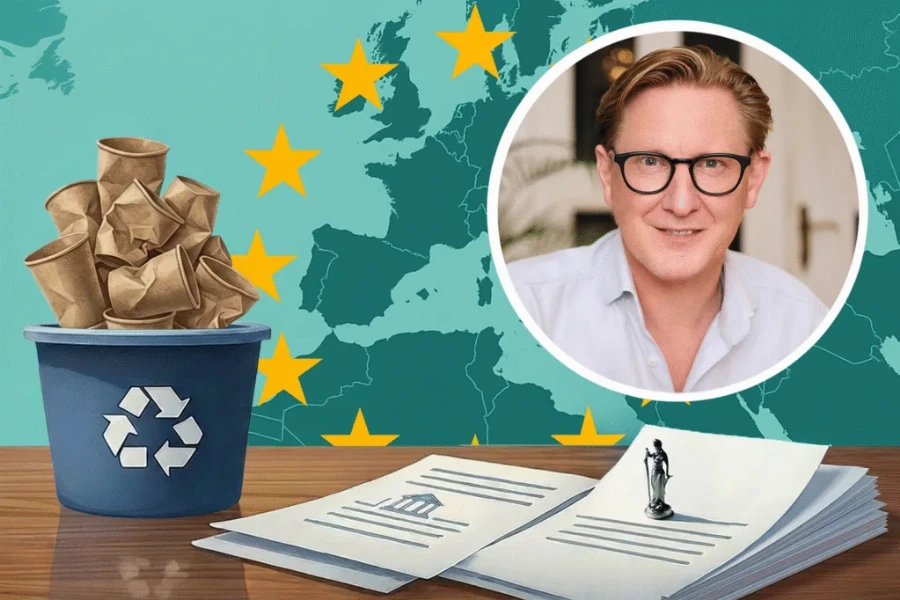
The SUPD has reached a point, four years and four months into practical application, where uncertainty is slowing innovation. Now is the moment to refine the directive scientifically – and finally provide Europe with a clear, practical polymer threshold.
Why Europe now needs a clear polymer threshold – and why the SUPD cannot function without it
The Single-Use Plastics Directive (SUPD, EU 2019/904) is approaching a turning point. Officially, its evaluation is not scheduled until 2027, but unofficially the Commission has already been working intensively on revisions for months. And this is urgently needed.
Because in practice, since its introduction in July 2021, it has become clear: with the current binary definition of plastics – “contains plastic = SUP” – it is impossible to regulate a modern, innovation-driven market. The result is misclassification, diverging national interpretations, and a climate of uncertainty that especially restrains those who are developing sustainable solutions.
The fact remains: market analyses show that the consumption of single-use packaging such as paper cups, trays or plates has not decreased since 2021. The SUPD does not remove these products from the market – it merely regulates them in a more complex way.
Innovation meets a patchwork of regulations
While classic PE-coated cups clearly fall under the SUPD, the situation for modern, strongly polymer-reduced or nearly polymer-free functional systems is completely different:
- Some Member States recognise these innovations and do not classify them as SUP.
- Others treat identical products as SUP – despite very low polymer content and good recyclability in the paper stream.
The result: technological progress is colliding with a European patchwork that slows rather than enables environmentally friendly innovation.
In many conversations over recent months, I increasingly hear the same issue from companies: they want to continue advancing innovative, polymer-reduced materials – technologically and strategically. At the same time, they openly question whether this path is economically worthwhile under the current SUPD framework. Several companies have told me that, despite better recyclability and lower environmental impact, conventional PE coatings are again being considered. The reason is simple: if an innovative and more expensive material remains regulatory unclear while potentially causing the same or even higher costs as the conventional alternative, innovation becomes a risk factor.
Science, NGOs, industry and new EU regulations: rarely so aligned
Remarkably, there is now a broad consensus:
- environmental organisations such as WWF or Rethink Plastic
- scientific institutes
- large parts of the converting industry
- and the new PPWR regulation
all point in the same direction: a quantitative, scientifically defined polymer threshold is necessary.
Paper science provides a clear foundation for this. According to scientific literature, polymer components of around 1.0% are technically necessary for the production of paper and paperboard alone in order to manufacture a stable and processable paper or board sheet. This includes, among others, binders, dispersing and functional additives, wet-strength agents and auxiliary substances used in paper production.
– Please find the scientific derivation by clicking on the link. –
Modern, innovative material systems, such as high-performance fibre-based cup systems, already achieve polymer contents below 1.0% by mass today – including barrier functionality, high recyclability and stable performance.
The PPWR shows where Europe is heading
With the 95/5 rule (at least 95% fibre content), the PPWR sends a clear signal in the packaging sector, following the current technical possibilities of recycling fibre-based materials. Europe is moving away from binary material definitions and towards quantitative, measurable criteria.
The SUPD, however, continues to operate in a black-and-white mode – an approach that no longer reflects market realities and will be untenable by 2027 at the latest.
Member states compared: Why 0.0% cannot work
Netherlands: The political ideal of complete polymer freedom (0.0%) proved technically unfeasible in practice. A cup without a minimal functional layer is not a cup. The rules were withdrawn and are now being reconsidered.
France: The planned 0.1% threshold (trace content) was suspended with the bilan d’étape in November 2025, as 0% plastic (or only trace amounts) is not technically or industrially realistic by 2026. The matter is now under renewed review and will be decided accordingly.
Italy: A 10% value stands in stark contrast to zero-approaches elsewhere and further increases European inconsistency.
Germany: Clear rules for conventional, polymer-intensive coatings contrast with unclear classifications – and even potential disadvantages – for modern, innovative coating systems.
Poland: Overly ambitious, strict 0.0% requirements without a valid analytical methodology lead to enforcement problems — in practice even to a regional patchwork and, consequently, increasing legal uncertainty.
Europe is more fragmented on the SUPD today than ever before.
Conclusion: A clear polymer threshold is the only way out of the stalemate
Europe needs a harmonised, measurable and enforceable threshold for polymer-containing fibre-based products under the SUPD. A limit just above the scientific minimum – that is, in a range slightly above 1.0% polymer mass content – would:
- enable and drive innovation rather than impede it
- make the SUPD workable
- create legal certainty and planning security
- ease enforcement burdens on authorities
- stimulate investment in sustainable material systems
- actually support the directive’s environmental objectives
- and return valuable material to the circular economy
As long as this harmonisation is missing, companies have only one path:
Test. Document. Certify.
Only then can modern, polymer-reduced systems be reliably distinguished from classic SUP products – and companies be protected from the consequences of a contradictory legal framework.
Europe stands at a decisive point.
The revision of the SUPD will determine whether it becomes a driver of sustainable innovation – or remains a brake.
About flustix
The organisation, founded in Berlin in 2017, offers six distinct flustix seals: The flustix LESS PLASTICS – MIN. xx% PLASTIC-FREE seals certify, in collaboration with recognised testing laboratories and accredited certification bodies, the entire product as well as either its packaging or the product itself. Products that refrain from using microplastics are transparently labelled with the PLASTIC-FREE – Product Content Microplastic-Free seal. The flustix RECYCLED trustmark certifies recyclates, semi-finished goods, and products with recycled content, including plastics, metals, and glass. flustix RECYCLABLE independently communicates the recyclability of packaging. The flustix seals serve as a guide for consumers and thereby support companies in pursuing a sustainability-focused business strategy and ensuring credible sustainability communication.